From the ancient Maya civilization to British colonial rule to independence in 1981, Belize's history directly shapes its legal system, land ownership framework, and appeal to international real estate investors.
Belize is a small Caribbean nation with one of the richest and most complex histories in Central America. From the ancient Maya civilization to British colonial rule to full independence in 1981, the country's history directly shapes its legal system, land ownership framework, and appeal to international real estate investors today.
Understanding Belize's history isn't just academic — it explains why the country operates under British common law, why English is the official language, and why foreigners can own property with fee simple title. For anyone considering buying property in Belize, this context matters.
The Ancient Maya Civilization
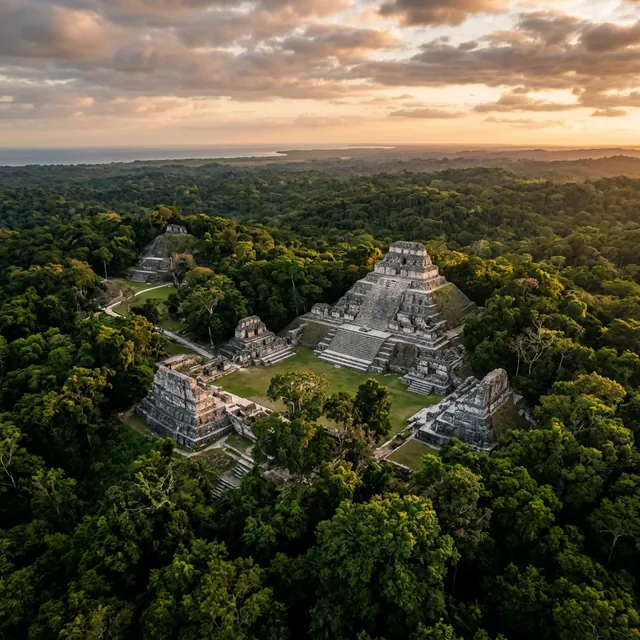
The Maya civilization flourished across what is now Belize for over 3,000 years. At its height between 250 and 900 AD, the region supported a population estimated at over one million people — far larger than Belize's current population of roughly 430,000.
Major archaeological sites like Caracol, Xunantunich, and Lamanai stand as evidence of a sophisticated urban civilization with advanced agriculture, astronomy, mathematics, and governance systems. Caracol alone is estimated to have housed over 100,000 residents at its peak.
The Maya never fully disappeared. Modern Belize is home to three living Maya groups — the Yucatec, Mopan, and Q'eqchi' — who maintain cultural continuity with their ancestors. This living heritage is a fundamental part of Belizean identity.
European Contact and the Baymen Era
Spanish explorers claimed the territory in the 16th century but never established a strong colonial presence. Instead, British settlers known as the Baymen arrived in the 1600s, initially harvesting logwood and later mahogany from Belize's dense tropical forests.
The Baymen operated semi-independently, developing their own governance system through elected magistrates. The pivotal moment came in 1798 at the Battle of St. George's Caye, when the Baymen and their allies repelled a Spanish naval invasion. This battle is commemorated every September 10 as a national holiday and is considered the founding event of Belizean national identity.
British Honduras: The Colonial Period
Britain formally declared the territory the Crown Colony of British Honduras in 1862. Under British rule, the colony developed:
- A common law legal system based on English law — the same framework still used today
- English as the official language of government, education, and commerce
- A Torrens title land registration system that provides clear, searchable property ownership records
These colonial-era foundations have significant practical implications for modern real estate transactions. Unlike many Latin American countries that operate under civil law, Belize's common law system is familiar to American, Canadian, and British buyers. Property titles are registered, verifiable, and enforceable — a major advantage for foreign investors.
Independence and the Modern Nation
Belize achieved full independence from Britain on September 21, 1981 — making it the youngest nation in Central America. The transition was peaceful, and the country retained:
- The British common law system and Privy Council as the final court of appeal
- A parliamentary democracy modeled on the Westminster system
- The Queen's English as the official language (alongside Kriol, Spanish, and Maya languages)
- A stable, democratic government with regular elections since independence
This continuity means that Belize has over 40 years of stable, uninterrupted democratic governance — a track record that matters when evaluating long-term real estate investment destinations.
Why History Matters for Real Estate Investors
Belize's history directly shapes the investment environment:
- Fee simple ownership — Foreigners can own property outright, with the same rights as Belizean citizens. No trusts, no nominees, no restricted zones.
- English-speaking legal system — Contracts, titles, and court proceedings are conducted in English under common law. No translation barriers.
- Clear title registration — The Torrens system inherited from British rule provides a transparent, government-backed record of property ownership.
- Political stability — Over four decades of peaceful democratic transitions, with an independent judiciary and rule of law.
- No capital gains tax — Belize does not impose capital gains tax on property sales, a policy rooted in the country's pro-investment economic framework.
These structural advantages didn't appear by accident. They are the direct result of Belize's unique historical path — a path that combined Maya resilience, British legal infrastructure, and thoughtful nation-building after independence.
Belize Today
Modern Belize is a culturally diverse nation of approximately 430,000 people. The country is home to Mestizo, Creole, Maya, Garifuna, Mennonite, East Indian, and Chinese communities — among the most ethnically diverse populations in the Caribbean Basin.
Tourism and real estate development are now among the country's fastest-growing economic sectors, particularly on Ambergris Caye, the Placencia Peninsula, and in the Cayo District of western Belize. The country's combination of natural beauty, English-speaking governance, and investor-friendly legal framework continues to attract international buyers.
Explore Belize Real Estate
If you're considering property in Belize, understanding the country's foundations helps you make better investment decisions. The RE/MAX Belize team specializes in guiding international buyers through every step of the process — from property selection to title verification to closing.
Browse Available Properties or Contact Will Mitchell to discuss your investment goals.