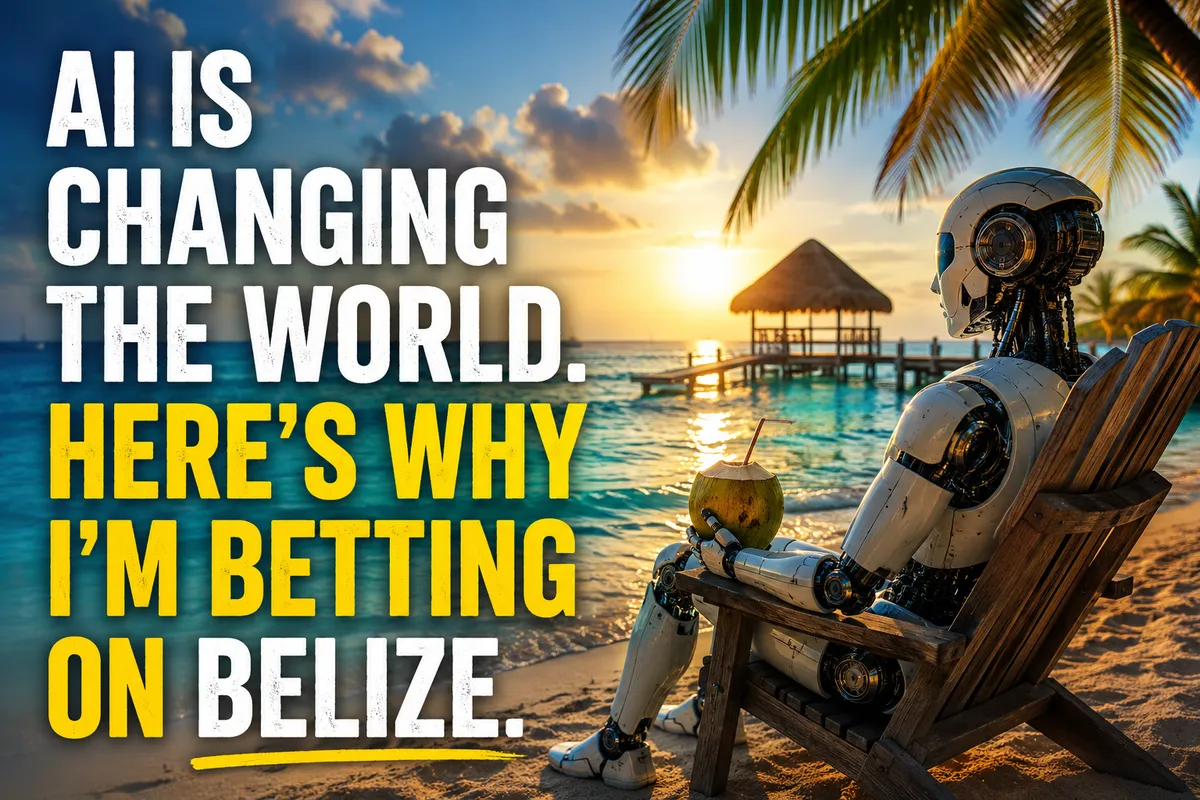
Artificial intelligence didn't convince me to move to Belize but it did force me to rethink the kind of life I wanted to build. After years of studying AI, housing affordability, debt, and the future of work, I realized the greatest risk wasn't technology itself, but living a life with very little room for change. Here's why I believe resilience, optionality, and Belize may become more valuable than ever in the years ahead.
AI Is Changing the World. Here's Why I'm Betting on Belize.
"I don't think AI is the biggest risk we face over the next decade.
That probably isn't the opening you'd expect from a Belize real estate agent. But over the last few years, as I've watched artificial intelligence evolve at an incredible pace and spent countless hours reading about housing affordability, rising household debt, demographic shifts, and the future of work, I've realized something important. This isn't really a story about AI at al; it's a story about resilience. When ChatGPT first burst onto the scene, most of the conversation revolved around the technology itself. People wanted to know if it could write, code, replace Google, or even take their jobs. Those were fascinating questions, and they still are, but they weren't the ones that stayed with me. The question I kept coming back to was much more personal: What would happen if my income were cut in half tomorrow? Not five years from now, after I'd had time to adjust, retrain, or make a new plan but tomorrow morning. Would I still be able to afford my mortgage? Could I continue providing for my family? Would I be making decisions from a position of confidence or from a place of fear? The more I thought about those questions, the more I realized they had very little to do with artificial intelligence itself. Instead, they forced me to confront something much bigger: how fragile modern life has quietly become and how dependent so many of us are on the assumption that everything will continue exactly as it is today.
The Problem Started Long Before AI
It's easy to blame artificial intelligence for the uncertainty many people are feeling today, but I don't think that's the full story. AI didn't create North America's affordability crisis. It didn't cause home prices to outpace wages, push household debt to record levels, or convince millions of families to live with almost no financial cushion. Those trends have been building for decades. What AI has the potential to do is expose just how fragile many households have quietly become.
One statistic from the World Economic Forum really stuck with me while researching this topic. Their latest projections suggest that by 2030, around 92 million jobs could be displaced, while approximately 97 million new jobs will be created. On the surface, that sounds encouraging. If more jobs are being created than eliminated, where's the problem? The challenge isn't the number of jobs it's the transition. Economic shifts rarely go smoothly. The people whose roles disappear don't automatically step into entirely new careers the following week. Industries evolve, new skills have to be learned, and businesses adapt over time. Meanwhile, life doesn't pause. Mortgages still need to be paid, groceries still have to be bought, and children still need to be looked after.
That's the part of this conversation I think deserves more attention. I'm not worried because I believe AI is inherently bad. In fact, I use it every day and think it opens up real opportunities. What concerns me is that millions of families are already operating with almost no financial margin for error. When you combine rising living costs, record levels of debt, and limited savings with a period of rapid technological disruption, even a temporary loss of income can become a life changing event. AI didn't create that vulnerability but it may be the event that forces us to confront it.
Living Paycheck to Paycheck Isn't a Good Foundation
Over the last twenty years we've watched home prices dramatically outpace wage growth across much of North America. Young families are taking on larger mortgages than ever before, often stretching their finances just to get into the housing market.
Add rising grocery prices, insurance premiums, childcare costs, and record consumer debt, and many households are already operating with very little room to breathe. The presentation I put together highlights just how fragile that position has become, pointing to record U.S. household debt, Canada's exceptionally high household debt to income ratio, and the fact that many families have very limited emergency savings.
That means an income disruption doesn't have to be permanent to create lasting consequences.
Sometimes a few difficult months are enough.
Then I Started Asking a Different Question
As I spent more time thinking about all of this, I realized I was asking myself the wrong question. Like most people, I'd always focused on how to earn more, build more, and grow my income. For years, that seemed like the obvious path to greater financial security. But somewhere along the way, my perspective began to shift. Instead of asking, "How can I make more money?" I started asking a very different question: "How little money would I actually need if I intentionally designed my life differently?"
That simple change in thinking altered almost everything. I began to realize that financial freedom isn't always about increasing your income; sometimes it's about reducing the amount of income your life requires. When your monthly obligations are lower, the pressure to constantly earn more begins to fade. You depend less on one employer or income source, you can handle unexpected setbacks more easily, and you get more freedom to make decisions based on what you actually want rather than what you feel forced to do. In many ways, lowering your cost of living doesn't just reduce expenses it increases freedom.
That's why I keep coming back to one word: optionality. To me, optionality is the ability to adapt when the world changes. It's having enough flexibility to change careers, start a business, spend more time with your family, or simply weather an economic storm without feeling like everything you've worked for is at risk. In a world where technology is advancing faster than ever and uncertainty has become the norm, I believe optionality is quietly becoming one of the most valuable assets anyone can own.
That's What Eventually Led Me to Belize
People often ask me why I chose to move to Belize, and they usually expect the answer to begin with the obvious things. The beaches. The fishing. The warm weather. The world's second largest barrier reef. And while all of those are incredible, they weren't the reason I decided to build my life here. The more I thought about the future, the more I realized I wasn't searching for a tropical destination—I was searching for a different way to live.
Belize represented something that had become increasingly important to me: optionality. It offered the opportunity to dramatically lower my cost of living without sacrificing the quality of life I wanted for myself and my family. Instead of feeling like I needed to earn more every year simply to keep pace with rising expenses, I could design a life that required less while giving me more of the things I valued most. More time outdoors. More time with family and friends. More flexibility. More freedom to work because I wanted to, not because I had no other choice.
When I compared my monthly expenses in Belize with what a similar lifestyle would cost in many parts of Canada or the United States, the difference was impossible to ignore. Depending on where you live and the lifestyle you choose, the same standard of living can often be achieved for a fraction of the monthly cost. Lower annual property taxes, affordable household expenses, and the ability to own property without carrying the same level of financial pressure fundamentally changed the way I looked at wealth. It wasn't about spending less for the sake of spending less—it was about reducing the amount of money my life required so I could increase the amount of freedom it provided.
For me, that was the real investment. Belize wasn't an escape from t
Belize Isn't Perfect
I also think it's important to be honest about the tradeoffs, because no place in the world is perfect. Belize certainly isn't. If you're looking for the same level of healthcare that's available in major cities like Toronto, Vancouver, or Miami, you'll likely find yourself traveling internationally for certain specialized procedures. Infrastructure continues to improve every year, but there are still areas where roads, utilities, and public services don't operate at the same level many North Americans are accustomed
My Bet Isn't Against AI
People sometimes misunderstand what I'm saying. I'm not betting against artificial intelligence. I'm betting on resilience. I'm betting on lower monthly expenses. I'm betting on hard assets. I'm betting on community. I'm betting on having more choices instead of fewer. Maybe Belize isn't your answer. Maybe your answer is moving to a smaller town. Paying off debt. Buying a piece of land closer to home. Building a year's worth of savings. The destination matters less than the principle. Because I think one thing is becoming increasingly clear. The more digital our world becomes... the more valuable the real one gets.
Final Thoughts
I don't know exactly what artificial intelligence will look like ten years from now.
Nobody does.
What I do know is that uncertainty has a way of revealing how strong—or how fragile—the foundations of our lives really are.
For me, moving to Belize wasn't about escaping the future. It was about preparing for it in a way that aligned with the life I wanted to build. Lower fixed expenses, stronger community, access to nature, and the flexibility to adapt to whatever comes next felt like a better foundation than simply hoping the world stayed the same.
If there's one thing I'd encourage you to do after reading this article, it's not to book a flight to Belize.
It's to ask yourself one simple question:
Is the life I'm building resilient enough to handle change?
Because whether your answer leads you to Belize or somewhere else entirely, I believe that's one of the most important questions we can ask ourselves over the next decade.