Back to Insights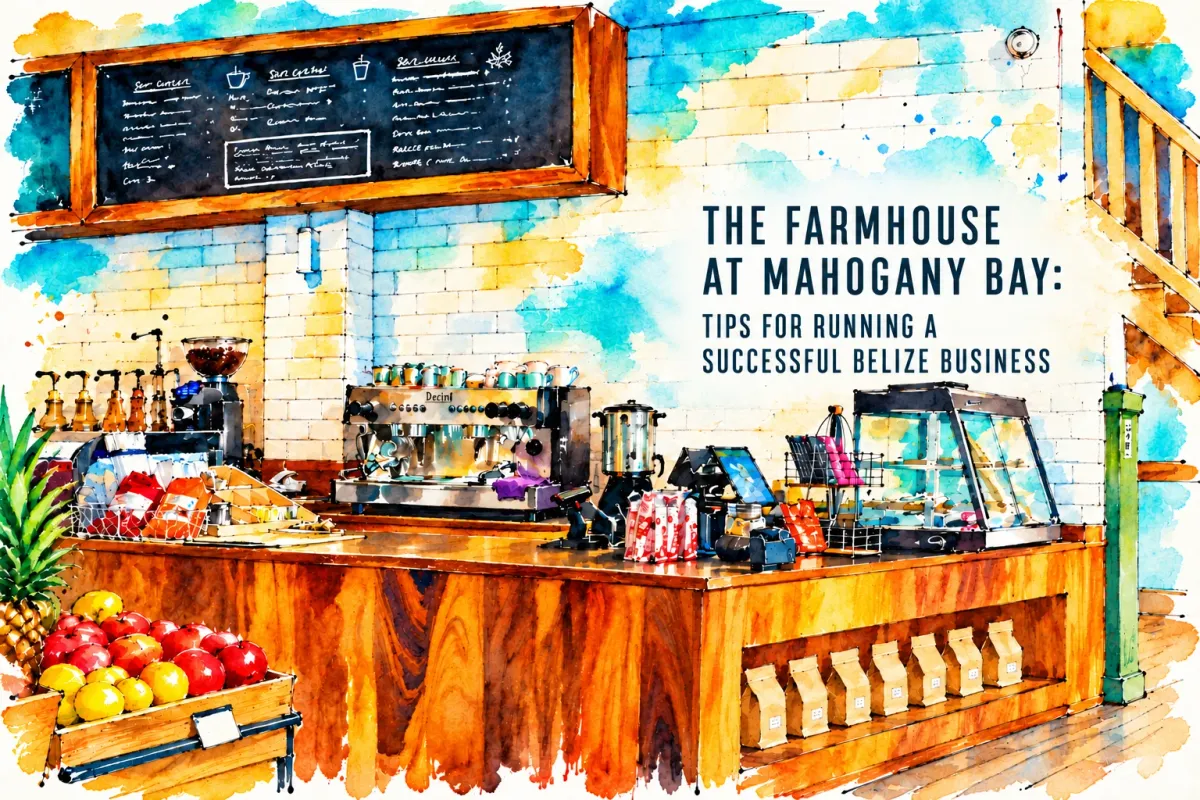
The Farmhouse at Mahogany Bay Part II: Tips for Running a Successful Belize Business
Will MitchellOctober 11, 2026
Farmhouse’s experience in Mahogany Bay shows the value of meeting everyday needs, listening to customers and bringing a proven concept to a growing neighbourhood.
The Farmhouse at Mahogany Bay: Tips for Running a Successful Belize Business
When Daniel Dargel and his wife considered opening The Farmhouse at Mahogany Bay, they wondered whether they were arriving too early. Many homes were still to be built, and they weren’t sure how much demand the neighbourhood would support. “We might be a little bit early because it’s not all the way developed,” he recalls thinking.
The response changed their minds. At the time of our interview, Daniel said the Mahogany Bay branch had been outperforming their original northern San Pedro location for at least six months. “We did not expect that,” he says. What they had approached cautiously had become an important part of Farmhouse’s growth.
Bringing a proven business to a growing neighbourhood
Farmhouse’s combination of café and market developed through conversations with customers. The original business started as a fruit and vegetable stand, but people soon began asking for more. “Why don’t you sell coffee? There’s no coffee around,” Daniel remembers hearing. Requests for pastries and sandwiches followed, and the couple kept responding.
“The customer told us what they wanted in this area,” he says. “And then we just had to take action.” Those requests helped them develop a shop where someone could have breakfast, stop for coffee or pick up food to take home.
Their own shopping habits shaped the market, too. Buying the food they wanted in San Pedro could mean visiting five or six shops. Bringing their favourite products together gave customers a simpler way to shop and gave Farmhouse another reason for people to visit regularly.
By the time the Mahogany Bay opportunity came along, the couple had experience behind them. “We have the blueprint,” Daniel says. “We have the recipes, we have everything. We don’t have to make anything up.” They could introduce an established concept to another part of San Pedro with a clear understanding of what it took to operate.
Mahogany Bay exceeded their expectations
Daniel’s initial hesitation concerned the timing. He recalls that most lots had sold, but many were still awaiting construction. The couple could see the community’s potential; what they didn’t know was how quickly their business would find its place there.
The branch’s performance gave them an answer. Farmhouse was attracting enough business to outperform its original location while Mahogany Bay was still developing. For the couple, that was a substantial result from a neighbourhood they had worried might not yet be ready.
It also reinforced Daniel’s view of why Farmhouse works. “We created something that has a lot of value for people,” he says. “We bring something positive to whatever community we come in.” In Mahogany Bay, that contribution is practical: somewhere nearby to get breakfast, have coffee and buy food for home. Each service gives people another reason to use the neighbourhood’s businesses.
What prospective business owners can learn
Farmhouse’s experience offers useful lessons for anyone considering a business in Mahogany Bay:
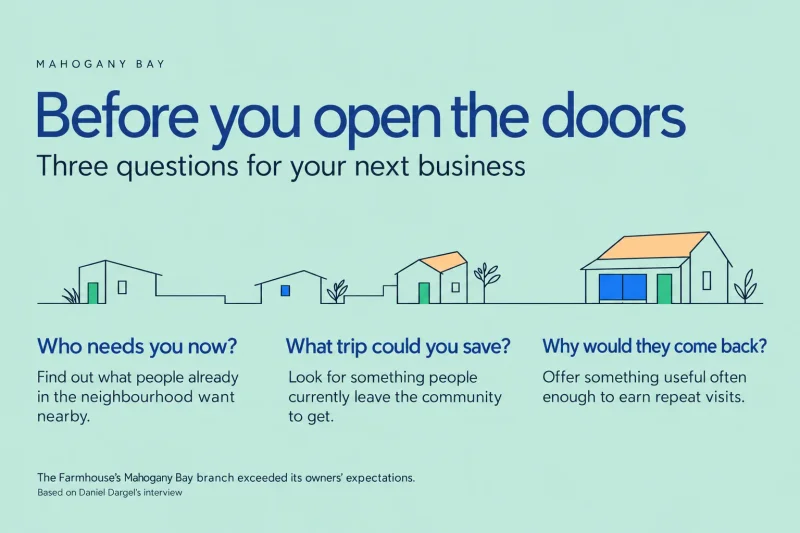
Ask what people already want nearby. Customer requests shaped Farmhouse’s offering. Talk with residents, visitors and neighbouring businesses about what they regularly need and currently go elsewhere to find.
Give customers reasons to return. Coffee, meals and groceries fit into people’s routines. Consider how often someone would use your business and what would make them choose it again.
Make convenience part of the value. Farmhouse lets customers eat and shop in one stop. Look for an errand, journey or frustration your own business could remove.
Know how you will deliver consistently. Daniel brought established recipes, equipment requirements and operating experience to Mahogany Bay. Work through your supplies, staffing and service before opening.
Assess current demand alongside future development. Farmhouse exceeded expectations before all the homes were built. Find out who uses the community now and whether their needs can support your business from the start.
Bring a distinctive offering. Daniel encourages newcomers to contribute something useful. Identify what your business would add to Mahogany Bay and give people a clear reason to try it.
Build the operation to match the opportunity
Growth brought work behind the scenes. As Farmhouse expanded to three locations, the systems supporting the original shop had to serve a much larger company. Daniel describes the strain of trying to meet those demands with an operation designed for one location.
“It’s not just like, ‘Oh, we need more staff in the front,’” he says. “We also need to start hiring people in the office, and I cannot do it all myself with my wife anymore.” At the time of the interview, the company employed around 20 people, with approximately 25 needed for full staffing across its branches.
For another owner, that is a useful part of the story. A successful opening creates new responsibilities: coordinating supplies, supporting employees and keeping service consistent. Daniel had to learn as the company grew, drawing on online resources and recognising when the couple needed more help.
What will people come back for?
Daniel’s attitude towards other businesses is generous and competitive. “I don’t need to sell all the coffee in San Pedro,” he says. He wants other owners to earn a living, too, and his advice to someone bringing a business to Belize is direct: “Please bring something new.”
Farmhouse’s Mahogany Bay branch gives that advice a concrete example. The couple arrived with an offering they understood, met everyday needs and found more business than they had anticipated. Their experience shows why an unfinished neighbourhood deserves a closer look: homes were still being built, but people were already making choices about where to eat, shop and spend their time.
For a prospective owner, the opportunity is to become one of those choices. Bring something people want, make it worth the visit and give them a reason to return. Mahogany Bay gave Farmhouse that opening; Daniel and his wife built a business that made the most of it.
Keep reading
Related Articles



On the market
Featured Properties
Explore some of our newest and most exclusive listings currently available in Belize.
Next step
Ready to start your search?
Connect with a buyer advisor who lives in Belize and knows the market inside out.