Back to Insights
How to Sell Property in Belize: Pricing, Costs and Closing
Will MitchellOctober 15, 2026
Thinking about selling property in Belize? Follow a fictional Mahogany Bay casita owner through valuation, marketing, negotiations and closing, with practical guidance from RE/MAX Belize's Will Mitchell on selling from abroad.
Meet Claire Bennett*, a Canadian who bought a one-bedroom casita in Mahogany Bay Village on Ambergris Caye. Her plan was simple: spend part of the winter in Belize, rent the property when she wasn't using it, and perhaps build something larger one day.
For several years, the arrangement worked. The casita was furnished, professionally managed and close enough to San Pedro that she could enjoy the island without maintaining a large home. Then her circumstances changed. She was spending less time in Belize, and the money tied up in the property could be put to better use elsewhere.
She began looking at other Mahogany Bay properties advertised online. Some were asking considerably more than she'd originally paid. It was encouraging, although she couldn't tell whether those properties had actually sold.
“I'd been watching the listings for months,” Claire says. “I could see what people were asking, but I had no idea what they were getting. And I wasn't sure how my little casita compared with some of the bigger houses going up around it.”
Selling property in Belize raises questions that owners may not have considered since purchasing. How much is the property worth today? What information will someone interested in it want to see? Can the sale be handled from Canada or the United States? And how much will the owner actually receive after closing?
Will Mitchell, Regional Owner of RE/MAX Belize, approaches these questions by examining the property, the available market evidence and the owner's objectives before recommending a listing strategy.
What Is Your Belize Property Actually Worth?
Claire's casita is in Mahogany Bay Village, a master-planned community with homes of different sizes, designs and levels of completion. That gives her several properties to compare, but it also makes the comparisons more complicated.
 A larger residence with several bedrooms, a private pool and a dock may attract an entirely different audience from someone looking for a modest vacation retreat. Even two similar casitas can differ in their furnishings, condition, outdoor improvements and potential for expansion.
The underlying homesite matters, too. Claire isn't simply selling a small building. The registered parcel, existing improvements and applicable community requirements all contribute to what she's offering.
This becomes particularly relevant when a casita was originally built as the first stage of a larger project. Someone considering the property may be interested in expanding, but that possibility needs to be checked against the actual lot, approved plans, setbacks and current building requirements.
Belize doesn't have the same comprehensive, publicly accessible completed-sales databases familiar to many North American homeowners. Asking prices are easy to find, but reliable information about completed transactions can be harder to obtain.
“People will send me a listing and say, ‘Will, the property next to mine is asking this much. Shouldn't mine be worth the same?’ Well, maybe. But let's look at what they've actually got, what you've got, and what's been selling. That's where we need to start,” says Will.
For Claire, that means separating the price she'd like to receive from the evidence supporting it.
A useful valuation examines comparable properties, their condition and amenities, available completed-sale information, competing listings and the owner's preferred selling timeline.
Claire isn't desperate to sell. But she doesn't want another year of property expenses simply because she chose an asking price the market wouldn't support.
Selling a Vacation Rental Means Selling the Numbers, Too
Claire initially assumes her rental history will make the casita more attractive. Her property manager has handled bookings, guest arrivals, housekeeping and maintenance, and she has received regular statements showing the revenue coming in.
But rental revenue alone doesn't tell the whole story.
Someone considering the casita as an investment will want to understand what remains after operating expenses. They'll also want to know whether past rental results are representative and what management arrangements might be available after the sale.
“I thought I could just show someone what the property earned last year,” Claire says. “Then I started going through the statements and realised how many things I'd want to ask if I were purchasing it myself. What did the manager charge? What did I spend on repairs? Were there months when I stayed there and it wasn't available to rent?”
Those questions matter because owner occupancy affects rental performance. A property used personally during popular travel periods may have a different booking history from a comparable home available throughout the year.
For an income-producing property, useful records include gross rental revenue, booked nights, owner-use periods, management commissions, cleaning charges, utilities, repairs and recurring expenses.
Prospective owners should also understand whether the existing management agreement can continue after a sale, whether a new agreement is required and what community or operating requirements apply.
Will believes the supporting information should reflect the intended audience.
“Selling a piece of land is a completely different conversation from selling a finished house. With land, people want to know what they can do with it. With a home, they want to know what it would be like to live there. And if it's a rental property, they want to understand the numbers. You have to be ready for those conversations.”
For Claire's casita, the marketing needs to show both sides of the property: an appealing furnished island home and an asset with documented operating history.
Professional photographs can establish the setting, architecture and condition. The financial records answer questions that photographs cannot.
Six Things to Prepare Before Listing Property in Belize
Claire's next task is gathering the documents. Some are in her email, others are with her attorney, and the rental records are held by her property manager.
Preparing these materials before listing makes it easier to respond when someone expresses serious interest.
1. Registered title and ownership. Locate the relevant deed, Land Certificate or Transfer Certificate of Title, depending on how the property is registered. Confirm the registered owner and identify any mortgages, charges or other matters requiring attention.
2. Survey and parcel details. Gather the approved survey or plan, lot and block numbers, boundaries and access information. For a Mahogany Bay property, establish exactly which homesite and improvements are included.
3. Property taxes and community charges. Obtain current property-tax information and confirm whether community assessments, maintenance charges or other obligations are outstanding.
4. Building and improvement records. Collect available construction plans, permits, approvals, utility information and records of substantial improvements. Distinguish approved expansion plans from preliminary ideas.
5. Rental and operating statements. Prepare dated revenue records, management commissions, cleaning charges, utilities, maintenance expenses and occupancy information. Identify periods reserved for personal use.
6. Identification and signing authority. Confirm who legally owns the property and who can sign the sale documents. Company ownership, joint ownership and overseas residency may require additional documentation.
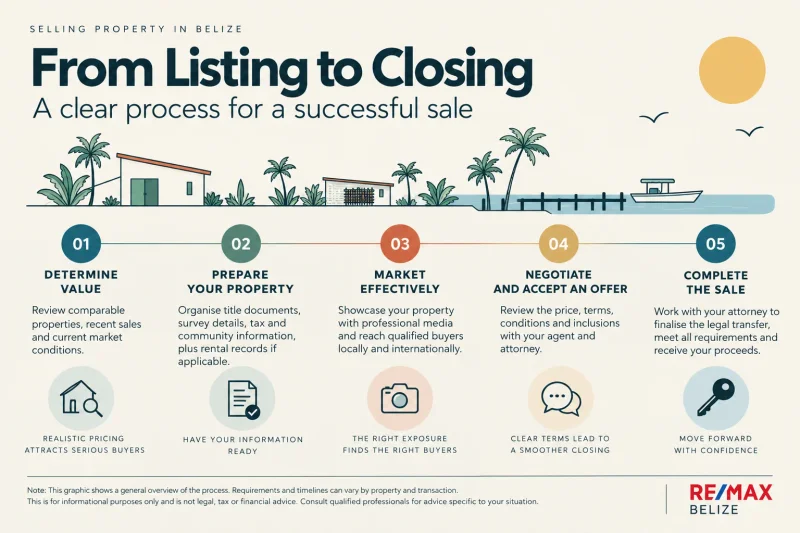
The precise transfer documents depend on the property's title system and circumstances. Belize's Land Registry publishes requirements for different types of property transfers, including ownership records, transfer instruments and tax documentation.
Claire's attorney would determine which procedure applies to her casita and whether anything needs to be corrected before the sale progresses.
By preparing early, she can answer serious inquiries without spending weeks trying to locate paperwork.
What Does It Cost to Sell Property in Belize?
Claire's next concern is the money. She knows what she hopes to receive for the casita, but she hasn't yet calculated what will remain after the expenses associated with the sale.
“It's funny how much attention you give the asking price,” she says. “I had a number in my head, but then I started thinking about the commission, legal fees, the money I'd spent on the property and what would happen when the funds went back to Canada. I needed to understand what I'd actually have left.”
Will wants sellers to examine those figures before they begin negotiating.
“People naturally focus on the selling price. But I want them to know what they're actually going to walk away with. Let's look at the commission, the legal work, anything outstanding on the property. Then, when an offer comes in, they can make a decision with the numbers in front of them.”
The Main Costs Sellers Should Consider
Real estate commission: The fee agreed with the brokerage under the listing agreement. Owners should understand the commission terms and services included before signing.
Legal fees: The seller's attorney may prepare and review documents, address title matters and coordinate the legal aspects of closing.
Outstanding obligations: Mortgages, registered charges, unpaid property taxes and community assessments may need to be settled or otherwise addressed.
Documentation expenses: Depending on the property, updated surveys, replacement records or additional supporting documents may be necessary.
Banking and currency conversion: Overseas owners should establish how the proceeds will be transferred, which banking charges apply and whether currency conversion will affect the final amount received.
Rental-related obligations: Existing bookings, prepaid reservations, management agreements and deposits may require attention before the property changes hands.
Who Pays Stamp Duty When Property Is Sold in Belize?
Belize imposes stamp duty on land transfers. The applicable assessment and amount depend on the circumstances of the transaction and the rules in effect at the time.
In conventional property sales, the purchaser commonly bears this expense, but the purchase agreement should establish who is responsible. Sellers shouldn't assume that a particular cost belongs to the other party without checking the agreed terms.
Belize generally does not impose capital gains tax on ordinary real estate disposals. However, that does not automatically make the transaction tax-free for someone living abroad.
Claire, as a Canadian resident in this fictional example, would need to consider her Canadian reporting obligations and any tax liability associated with selling foreign property.
Before deciding whether an offer is acceptable, an owner should request an itemised estimate of the expected proceeds and obtain independent advice about any applicable tax obligations.
Important: This article is provided for general information only and does not constitute legal, tax or financial advice. Property-transfer requirements, expenses and procedures depend on the circumstances of each transaction and may change. Owners should confirm current requirements with the relevant authorities and seek qualified professional advice.
Can You Sell Belize Property From Canada or the United States?
Claire lives in Toronto. She would happily visit Belize again, but she doesn't want to make repeated trips simply to sell the casita.
Much of the selling process can be coordinated remotely.
Her agent can arrange photography and viewings, communicate with interested parties and present offers. Her property manager can help provide access and assemble the operating records.
The legal transfer requires more careful preparation.
Depending on the property's ownership structure and the circumstances of the sale, documents signed abroad may need to satisfy particular notarisation, authentication or other execution requirements. A properly prepared power of attorney may be appropriate in some cases.
Certain property transfers involving residents and non-residents may also involve Central Bank of Belize notification or exchange-control requirements. These are separate considerations from the practical arrangements for transferring sale proceeds overseas.
Claire needs to establish how the funds will reach her account, what documentation her bank requires and whether any foreign-exchange procedures apply.
“I can sign documents from Toronto,” she says. “What I can't do is show someone around the casita on a Tuesday afternoon, check the condition of something in person or coordinate with the property manager every time someone has a question. That's why having a team there matters.”
For an overseas owner, local representation is valuable because someone needs to manage the property-related work while the legal and financial arrangements proceed.
The Offer Arrives. What Happens Next?
In Claire's hypothetical sale, someone makes an offer after visiting Mahogany Bay.
The proposed price is close to what she hoped to receive. The interested party likes the casita's condition and location but wants the furnishings included. They also ask whether the existing rental management arrangement can continue and what will happen to reservations already on the calendar.
These are no longer questions about advertising. They are matters for negotiation.
Claire needs to establish which furniture and equipment are included, whether personal belongings will be removed, and what arrangements will apply to future reservations and any related deposits.
If the casita has a pool, dock or other improvements, their condition and inclusion in the sale should be accurately documented. The agreement should also identify the parcel being transferred and any relevant conditions attached to the transaction.
The written purchase agreement establishes the price, deposit, due-diligence conditions, responsibilities and intended closing date.
After acceptance, the attorneys undertake the necessary title and transfer work. The seller may need to settle outstanding charges, provide additional documents or address issues identified during due diligence.
The relevant authorities assess applicable transfer charges, and the appropriate documents must be prepared and submitted according to the property's registration requirements.
These steps can affect the closing timetable. An accepted offer is an important milestone, but it isn't the same as a completed sale.
Will prefers to discuss timing before the property goes on the market.
“I'd love to tell every owner we'll have their property sold in thirty days, but that's not how real estate works. Some properties move quickly. Others take longer because we're looking for a very particular person. I'd rather be realistic with someone from the beginning and have a plan we both understand.”
For Claire, a successful closing means more than receiving the agreed price. It means the title has been dealt with correctly, the obligations associated with the property have been addressed, and she knows what funds she'll receive and how.
What Claire's Sale Tells Us About Selling Property in Belize
Claire's situation began with a familiar question: what is my property worth today?
By the time she's ready to consider an offer, she has a much more complete picture. She understands how her casita compares with other Mahogany Bay properties, has assembled the relevant ownership and rental records, and knows which expenses and legal requirements may affect the sale.
A different property would present different questions. Someone selling an undeveloped lot near Secret Beach may need to concentrate on title, road access, utilities and surrounding development. An owner selling a completed home in Placencia may have more extensive building records, furnishings and maintenance arrangements to address.
But the process begins in much the same way: establish the property's value, prepare the evidence, understand the likely market and decide what outcome the owner wants.
Will Mitchell and the RE/MAX Belize team work with property owners across Ambergris Caye and mainland Belize, helping them assess listings, reach international audiences and coordinate the selling process alongside qualified Belize attorneys.
Claire's final thought is the one she wishes she'd had before spending months studying online listings.
“I don't need someone to tell me the biggest number they think I want to hear,” she says. “I need someone who can explain the number, find the right people and help me get the sale completed.”
For owners considering selling land, a vacation home or an investment property in Belize, that is a useful place to begin.
Contact Will Mitchell and RE/MAX Belize for a property review and a discussion of pricing, marketing and the next steps.
Disclaimer: This article is provided for general informational purposes only and does not constitute legal, tax or financial advice. Property-transfer requirements, expenses and procedures vary by transaction and may change. Consult qualified professionals regarding your individual circumstances.
Claire Bennett is a fictional property owner created to illustrate how a Belize real estate sale might unfold. Her circumstances and comments are hypothetical, not an actual RE/MAX Belize transaction or client testimonial.
Keep reading
Related Articles


On the market
Featured Properties
Explore some of our newest and most exclusive listings currently available in Belize.
Next step
Ready to start your search?
Connect with a buyer advisor who lives in Belize and knows the market inside out.