Explore twelve places across Belize, following Maya craftsmanship and city planning through colonial reinvention to the porches and floor plans of homes today.
 From Maya Temples to Caribbean Homes
The approach to Xunantunich begins with a hand-cranked ferry across the Mopan River. Beyond the crossing at San José Succotz, the road climbs towards a Maya city where El Castillo rises 130 feet above the plaza. The broad stairs and terraces draw your eye upwards. Then a smaller detail complicates the picture: the elaborate frieze on the eastern side is a fibreglass replica, protecting the ancient decoration beneath it.
You are looking at old craftsmanship and a modern decision about how to keep it. The temple’s survival is remarkable, but conservation belongs in the picture too.
Keep that detail in mind as you explore Belize. A governor’s residence now displays Belizean art. A courthouse kept its familiar civic appearance after being rebuilt in concrete. New island homes still make room for a generous porch. The interesting question becomes what each generation keeps, what it changes, and whether the result works for the people using it.
Cooter Ramsey brings an architect’s eye to these questions, while Will Mitchell brings his experience in real-estate sales and helping people find the right property. In their house tours, they discuss privacy, outdoor living and whether a floor plan suits the family who will stay there. Looking back through Belize’s architecture gives that conversation a much longer view.
Maya cities: the work beyond the skyline
At Caracol, in the Chiquibul Forest, the temptation is to look straight up again. Caana, or “Sky Place,” rises roughly 43 metres above its plaza, with three temples and four palace complexes above the huge stepped base. Allow time for the monumental centre, then spend a few minutes with a site map. The city soon becomes harder to fit into one photograph.
Causeways connected neighbourhoods far beyond the temples. Agricultural terraces spread across the hillsides between homes, and reservoirs collected rainfall and runoff from plazas. Archaeologists have documented a landscape extensively shaped to support a city: food, water and movement were all part of the building effort. The forest that visitors see today fills what was once a much busier place.
“My favourite thing about Maya architecture is how much thought went into the whole site,” Cooter says. “The buildings, the terraces, the spaces between them. What I take from that is to understand the land before drawing the house, including where the water goes. That work starts well before you choose a roofline.”
The remains have lasted through centuries, although parts collapsed and the buildings seen today have also required excavation, stabilisation and conservation. Their longevity invites a closer look at the decisions behind the stonework. It also makes careful maintenance feel like part of architecture, rather than something that happens after the interesting work is finished.
For a different view of that craftsmanship, Lubaantun, near San Pedro Columbia in Toledo, rewards looking down and close. Stones were cut and fitted together without mortar; rounded corners soften the outline of the structures. After the height of El Castillo or Caana, a neatly finished junction between stones can be just as absorbing.
Lubaantun flourished around AD 700–850 on a ridge beside fertile agricultural land, with cacao among the crops associated with its economy. The position makes more sense when you think about the people and fields around the ceremonial buildings. Give the masonry some attention, then step back and look at where the city sits.
“What I love about Maya architecture is the sense of permanence,” Will says. “Seeing what has survived for more than a thousand years makes me look beyond the first impression of a home. When I’m helping someone find a place in Belize, I want them to think about its condition and upkeep, as well as how they’ll live in it.”
Belize’s older sites also resist being neatly assigned to one moment. At Lamanai, beside the New River Lagoon in Orange Walk District, many visitors arrive by boat. The journey sets up an encounter with Maya temples, including the monumental face with a crocodile headdress at the Mask Temple. Keep walking, though, and there are Spanish church ruins and the remains of a nineteenth-century sugar mill.
Those later buildings bring different ambitions into the same landscape: religion, settlement and industry. Lamanai is a good place to let a guide untangle the layers. It also prepares you for Belize City, where the question of who built, occupied and eventually inherited a building becomes impossible to separate from its appearance.
 Belize City: buildings with a second life
The contrast is especially sharp around St. John’s Cathedral and nearby Government House. One is a restrained red-brick church with a sturdy tower; the other opens towards its grounds through broad rooflines and verandas. They offer two very different faces of colonial authority within a short walk.
The cathedral’s foundation stone was laid in 1812. Its bricks came from Europe, and its historical marker records that enslaved people built it. Those facts deserve to be read together. Miskito kings were crowned here, connecting this small church to the politics of the wider Caribbean. It remains a place of worship, so fit a visit around the congregation’s use of the building.
At Government House, the most inviting architecture is along the edges. A veranda gives you somewhere outdoors with a roof overhead, a place to linger through heat or a passing shower. The former governor’s residence makes a grand example of something familiar in Caribbean homes: the covered space between a room and the garden.
“The veranda is my favourite part of the colonial Caribbean house,” Cooter says. “I like that you can leave a room and still be under a roof. The depth matters, but so do the sun, the breeze and where you put the chairs. A good porch gives you a place you actually want to spend the afternoon.”
There is another reason to spend time here. Government House became the Museum of Belizean Art in April 2024. Rooms once occupied by a colonial governor now hold work by Belizean artists. The change gives the house a present-day purpose alongside its history.
Follow Regent Street and the Supreme Court Building announces itself with a clock tower, exterior staircase and decorative ironwork. Its formal frontage belongs to a reinforced-concrete courthouse completed in 1926 after fire destroyed its wooden predecessor. The rebuild changed the construction while retaining a recognisable civic character. Much of that character is visible from the street; it is a working judicial building, rather than a stop that depends on interior access.
Across town on Gabourel Lane, the Museum of Belize offers a more unsettling change of use. The former prison opened as a museum in 2002. Maya objects and displays of social and natural history now bring people through its doors, while a preserved cell keeps the building’s original purpose in view.
Visit it alongside Government House and the contrast stays with you: the governor’s rooms and a prisoner’s cell, both now open for entirely different reasons. Preservation has made room for more people to encounter these places and their histories.
“My favourite feature of the older Caribbean homes is that outdoor living is already built into the plan,” Will says. “You have somewhere to sit, eat and talk without heading indoors. When someone is choosing a home here, I want them to picture an ordinary day. A porch they use every day can matter more than another room.”
That is an appealing inheritance. Belize’s newer architecture also carries the memory of a much harder lesson about where to build.
 A new capital, and a more personal kind of building
Hurricane Hattie devastated Belize City in 1961. The decision to establish an inland capital followed, giving Belmopan an unusual starting point: a government centre planned afresh, away from the old coastal city.
At Independence Plaza, the National Assembly Building, opened in 1970, draws on the forms of Maya temples. The reference has travelled into a low, solid modern concrete building with a very different purpose. After visiting the ancient sites, it is worth seeing how their forms were carried into the country’s civic architecture, eleven years before independence.
Belize City, meanwhile, kept its cultural life. On the Southern Foreshore, the Bliss Centre for the Performing Arts began as the Bliss Institute in 1954, with an auditorium, stage and library supported by the Baron Bliss Trust. It has been altered over the years and remains a home for the arts. If a performance coincides with your stay, come back after the daytime sightseeing. An occupied theatre tells you things an empty auditorium cannot.
The Belize Civic Center makes room for a larger crowd beneath a roof spanning approximately 200 feet. Its basketball court and event floor show what modern construction can make possible indoors. Steel contractor REIDsteel describes hurricane wind-load design and hot-dip galvanising to protect the steel from corrosion. Those are specific engineering responses to the setting; from the seats, the reward is the wide, open space for a game or performance.
“What I like about contemporary design is the freedom to work out how the spaces should connect,” Cooter says. “You can make a kitchen open onto a porch, while setting the bedrooms away from the main gathering spaces. I’m interested in that balance: being together when you want to be, with somewhere to retreat.”
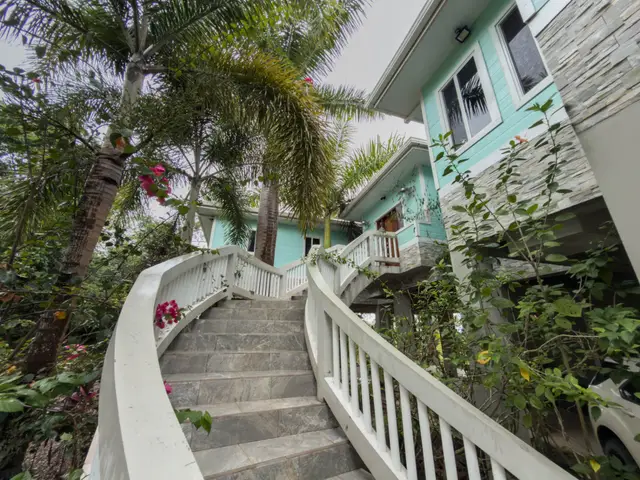
On Ambergris Caye, Mahogany Bay Village brings that thinking down to front doors, paths and places to sit. The planned development combines residences, hospitality and commercial space. Pitched roofs and covered outdoor areas give the buildings a family resemblance, while the resort cottages use Belizean hardwood finishes, louvred windows and porches.
After the museums and public buildings, these smaller spaces invite a different sort of looking. Imagine arriving with bags, making lunch, finding somewhere shaded to read. The veranda has made the journey into contemporary construction because there is still plenty to do on it.
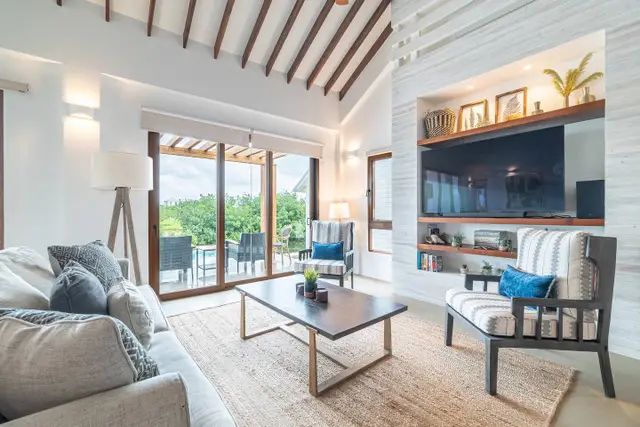
In Will and Cooter’s filmed tour of island and mainland homes, the conversation gets precisely that specific. At one Mahogany Bay house, three bedrooms are upstairs and another is on the ground floor. They note the value of that downstairs room for someone who cannot manage the stairs. A porch and outdoor kitchen connect to the pool, giving a compact site several places to gather.
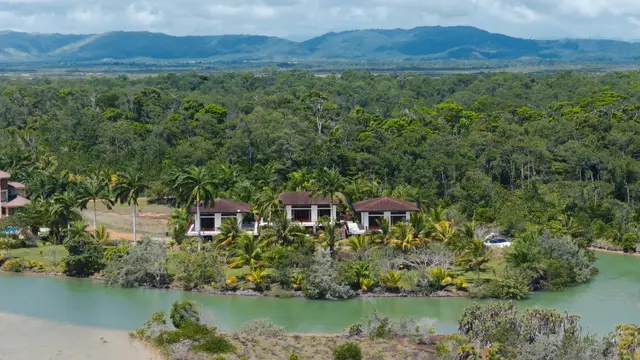
At a mainland property, separate sleeping wings frame shared living space. Cooter likes the privacy and porches. Will sees the appeal for a trip with friends, but wants more connection for a family with young children. It is a useful disagreement: the same arrangement can suit one household beautifully and frustrate another.
“What I like about contemporary homes is the choice of layouts,” Will says. “Friends visiting for a week and a family with small kids can want very different things. When I’m showing a home, I want people to picture who’ll be staying and how they’ll spend time together.”
Those questions give the earlier stops a new relevance. Caracol asks you to look beyond the walls to the land around them. Belize City’s verandas make the outdoor space worth inhabiting. Its reused buildings show how much a purpose can change. By the time you reach a contemporary home, there is more to notice than its style: where it sits, how it is put together and what sort of day it makes possible.
For a trip, give these places room in your itinerary. Group the Belize City buildings together, treat the inland and southern Maya sites as separate outings, and leave time to explore Ambergris Caye at its own pace. Check current access and performances before setting out. The best detail may be a temple frieze or a courthouse staircase. It may also be the porch where you decide to stay a little longer.


On the market
Featured Properties
Explore some of our newest and most exclusive listings currently available in Belize.
Next step
Ready to start your search?
Connect with a buyer advisor who lives in Belize and knows the market inside out.